Affluent retirees are increasingly discussing a sequencing strategy that flips the usual order of retirement income: convert traditional retirement assets to Roth accounts in the early 60s, then wait until 70 to claim Social Security. In a Sept. 12 report, 24/7 Wall St. described the approach as a way to use the low-income years after work ends to reduce later taxes, required minimum distributions and Medicare premium surcharges.
The core idea is straightforward. For some households, the years between the last paycheck and the start of Social Security or RMDs can be unusually tax-efficient. Those years may allow sizable Roth conversions at 12% or 22% rates, while delaying Social Security can increase the eventual monthly benefit and raise the survivor benefit for the higher earner's spouse.
What changed
The development is not a new law or IRS ruling. It is a shift in how higher-asset couples are approaching retirement-income sequencing. The strategy is getting more attention among affluent do-it-yourself investors and planners because it aims to solve a later problem: large pre-tax balances can create high RMDs once distributions begin at 73, especially when combined with Social Security and any pension or investment income.
24/7 Wall St. illustrated the issue with a married couple, both age 62, holding $1.8 million in traditional 401(k) assets and $400,000 in a taxable brokerage account. If wages have stopped and the couple is not yet claiming Social Security, their reported income may be low enough to make conversions comparatively cheap from a tax perspective.
Who is affected
This framework is aimed at affluent households with substantial traditional IRA or 401(k) balances, some taxable assets available to cover living costs and taxes, and flexibility over when to claim Social Security. It matters most when retirement begins well before RMD age and after wage income has dropped to zero or near zero.
In the example cited, the couple has about $15,000 of annual dividends and interest. Against a 2026 standard deduction of $32,200 for married filing jointly, that leaves no taxable income before any conversion. According to the report, that creates room to convert roughly $114,000 and still remain at the top of the 12% bracket, which it lists as $96,950 of taxable income for joint filers in 2026. The same example says the 22% bracket runs up to $206,700 of taxable income.
The households most likely to consider this are those worried that waiting too long could push future withdrawals into higher brackets once multiple income streams arrive at once. That can also matter for Medicare because IRMAA surcharges on Part B and Part D use a two-year lookback.
The after-tax math
The argument for earlier Roth conversions is that they may trade known tax rates in the 60s for potentially higher effective tax costs later. Those later costs can include ordinary income tax on RMDs, taxation of up to 85% of Social Security benefits, and higher Medicare premiums.
Example: a retired couple at 62 has no wages, $15,000 of investment income, and enough taxable assets to pay conversion tax from outside the IRA. If they convert about $114,000 in a year, the report says they can still stay within the 12% bracket because the standard deduction offsets the first $32,200 of income.
| Illustrative item | Amount |
|---|---|
| Traditional 401(k) balance at retirement | $1.8 million |
| Taxable brokerage assets | $400,000 |
| Annual dividends and interest | $15,000 |
| 2026 standard deduction cited | $32,200 |
| Approximate conversion while staying in 12% bracket | $114,000 |
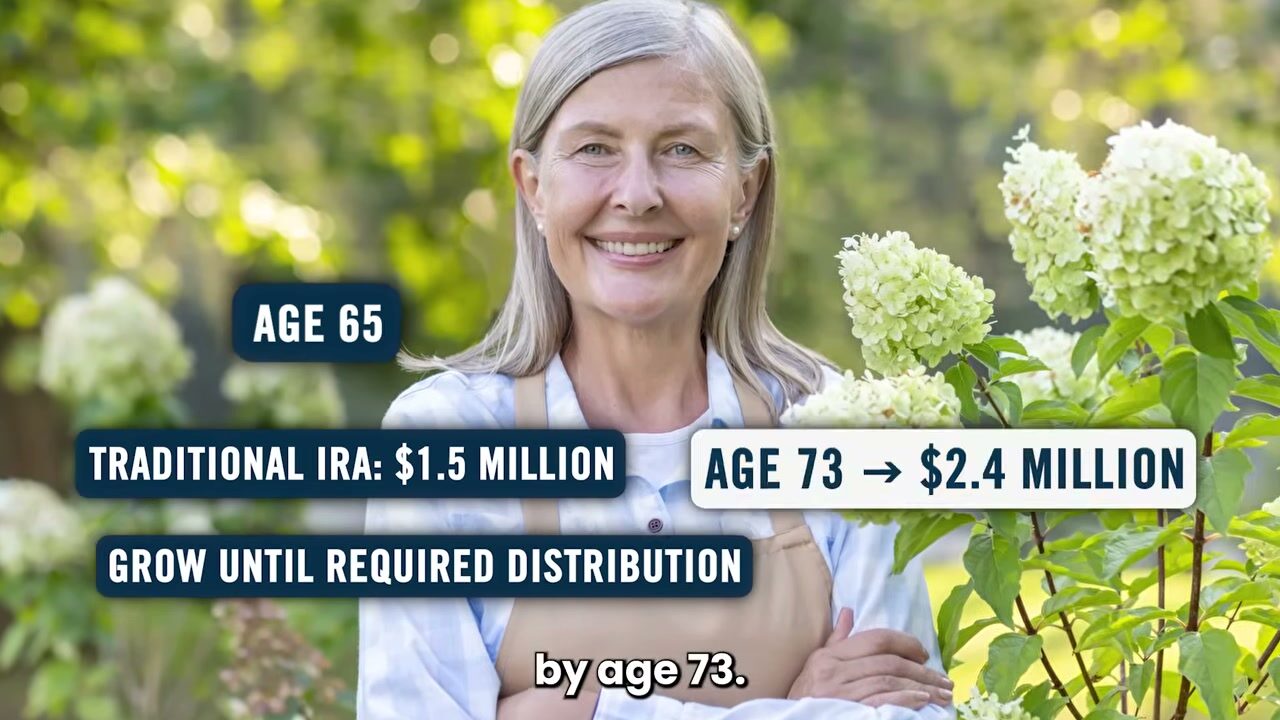
The report then contrasts that with doing nothing. If the $1.8 million grows at 6% for 11 years, it reaches roughly $3.4 million by age 73. It estimates a first-year RMD of about $128,000. If the couple has also delayed Social Security to 70, their two checks could total about $80,000 a year. In that setup, the article says the couple could land in the 24% federal bracket, with up to 85% of Social Security becoming taxable and IRMAA surcharges adding several thousand dollars per person annually.
That is the tax trade: pay some tax earlier, at lower marginal rates, in exchange for a smaller traditional balance later and lower forced withdrawals.
Why age 70 is part of the strategy
The Social Security side of the strategy is not mainly about taxes. It is about increasing the benefit base. The report notes that each year after full retirement age adds 8% to the base benefit until age 70, and that larger benefit is inflation-adjusted thereafter.
For married couples, the survivor benefit is a major consideration. If the higher-earning spouse delays, the surviving spouse can receive that larger delayed benefit. Claiming at 62 instead locks in a lower monthly amount for life for the spouse who outlives the other.
The report also argues that households comparing the delayed-credit value with conservative investments may see the Social Security increase as attractive. It cites a nearly 5% yield on the 10-year Treasury and a national average 12-month CD yield just under 2%, versus an 8% annual delayed retirement credit.
Moves to discuss with your advisor
Households in this situation often consider mapping annual conversions year by year, first filling the 12% bracket and then evaluating whether the 22% bracket still makes sense. The report says many are trying to stop before crossing the first IRMAA tier because Medicare premiums are based on income from two years earlier.
Another planning point is where the tax payment comes from. In the example, paying conversion tax from the taxable account preserves more of the Roth account's tax-free shelter. The report also notes that using IRA assets to pay the tax before age 59 1/2 can trigger a 10% penalty.
Not every affluent retiree will reach the same answer. The strategy depends on health, spending needs, asset mix and the size of pre-tax accounts. But the logic is clear: for some high-balance couples, the years from 62 to 70 may be less about when to start benefits and more about how to use a temporary low-tax window before RMDs and Social Security begin to stack up.
Sources
After TAX is an independent publication. Articles are general information, not tax, legal or investment advice. Consult a licensed professional about your situation.