A first required minimum distribution can create a larger tax effect than the withdrawal alone suggests. In the example highlighted by 24/7 Wall St. on September 14, a single retiree’s $24,000 IRA withdrawal was fully taxable and also caused another $6,600 of Social Security benefits to become taxable. The key mechanism is the provisional-income formula used to determine how much of Social Security is taxed.
What Changed
Nothing in the law changed this week. The development is a reminder of how the existing rules interact once retirees reach the age for required minimum distributions. The cited example centers on a first RMD at age 73, which the report describes as the current RMD start age, and shows how that withdrawal can push income over Social Security taxability thresholds that have not been indexed to inflation.
Under the formula described in the report, provisional income includes adjusted gross income, any tax-exempt interest, and half of Social Security benefits. For single filers, once provisional income exceeds $25,000, up to 50% of benefits become taxable; above $34,000, up to 85% may be taxable. For married filers, the comparable thresholds are $32,000 and $44,000.
Because an RMD flows into adjusted gross income, it can increase provisional income dollar for dollar. That means a withdrawal intended simply to satisfy the distribution rules may also expose a larger share of Social Security benefits to tax.
Who Is Affected
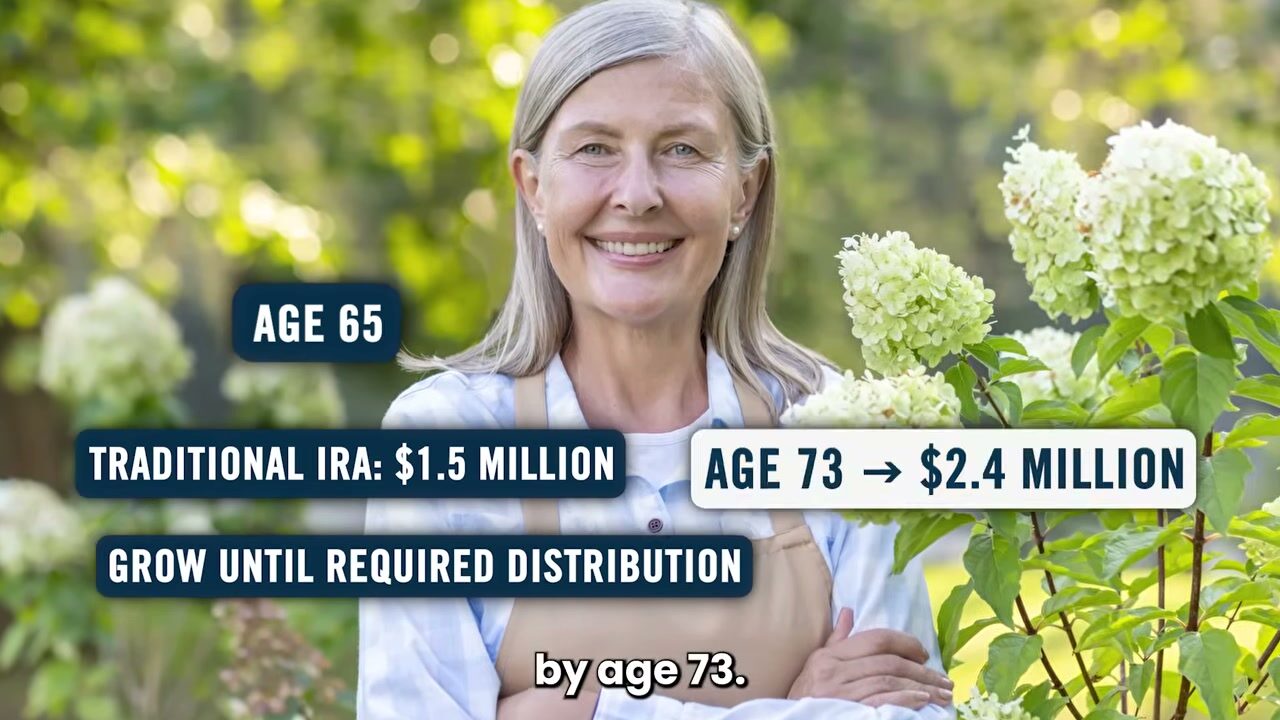
The setup is most relevant for retirees with traditional IRA balances large enough to produce meaningful first-year RMDs and who are already collecting Social Security. The report says a first RMD near $24,000 is a reasonable benchmark for someone whose traditional IRA has grown into the mid-six figures by age 73.
The issue can be more pronounced for households with multiple income sources. The report notes that CD interest counts as ordinary income for this purpose, and that I bond interest enters the same provisional-income calculation when it is redeemed or reported. It also cites the FDIC national average 12-month CD rate at 1.71% as of August 1, 2026, and says I bonds issued from May 1, 2026 through October 31, 2026 carry a 4.26% combined rate.
Higher Social Security benefits can also narrow the gap before those thresholds are reached. The report says Social Security transfer receipts rose to $1,645.4 billion in the second quarter of 2026 from $1,469.1 billion in the fourth quarter of 2024, and that the 2027 cost-of-living adjustment was tracking toward 3.3% with two of the three third-quarter months available. Bigger benefits increase the half-benefit figure used in the provisional-income test.
The After-Tax Math
The example in the report is straightforward. A retiree takes a $24,000 RMD from a traditional IRA. That $24,000 is itself taxable. But the withdrawal also raises provisional income enough that another $6,600 of Social Security becomes taxable.
That does not mean the retiree paid tax twice on the same dollar in a technical sense. Rather, the withdrawal increased taxable income in two places on the return: first through the IRA distribution, and second through the newly taxable portion of Social Security benefits. The report says that, in the example, both amounts fall into the 22% federal bracket for a single filer, which it lists as $48,476 to $103,350 for 2025.
| Illustrative item | Amount |
|---|---|
| RMD included in income | $24,000 |
| Additional Social Security made taxable | $6,600 |
| Total increase in taxable income | $30,600 |
| Illustrative tax at 22% | $6,732 |
Example: if the full $30,600 increase is taxed at 22%, the added federal tax would be about $6,732. This is an illustration based on the figures cited in the report, not a full tax calculation. Actual returns depend on filing status, deductions, other income, and how much of Social Security was already taxable before the RMD.
Moves to Discuss With Your Advisor
The report outlines several planning levers households often review before the first RMD year. One is partial Roth conversions between retirement and age 73. The tradeoff is paying tax earlier on the converted amount in exchange for reducing the traditional IRA balance that later generates mandatory distributions.
Another is the qualified charitable distribution. The report says QCDs can send up to $108,000 per year in 2025 directly from an IRA to charity, satisfying the RMD without adding that amount to adjusted gross income.
A third variable is Social Security timing. The report says delaying benefits to age 70 increases the eventual monthly benefit but shortens the overlap period in which Social Security and RMDs are both hitting the return. Households in this situation may want to model those options carefully with a CPA or financial planner, especially when other income sources such as interest are also in the mix.
What to Watch
The broader policy backdrop may matter. According to the report, Fortune and CNBC reported on September 13 that lawmakers in both parties were paying more attention to tax changes tied to Social Security funding as insolvency approaches, while Kiplinger examined the tax effects of a flat-rate cost-of-living adjustment structure. Any future change to Social Security taxability thresholds, tax brackets, or COLA design could alter how much of a future RMD triggers this second layer of taxable income.
For now, the main point is that retirees nearing their first RMD year may need to look beyond the withdrawal amount alone. When provisional income crosses the long-standing thresholds, the tax cost can be larger than the distribution itself suggests.
Sources
- First reported Her First RMD Was $24,000. It Made Another $6,600 of Her Social Security Taxable on Top, So the IRS Got Paid Twice on One Withdrawal — 24/7 Wall St.
- Her First RMD Was $24,000. It Made Another $6,600 of Her Social Security Taxable on Top, So the IRS Got Paid Twice on One Withdrawal — AOL
After TAX is an independent publication. Articles are general information, not tax, legal or investment advice. Consult a licensed professional about your situation.