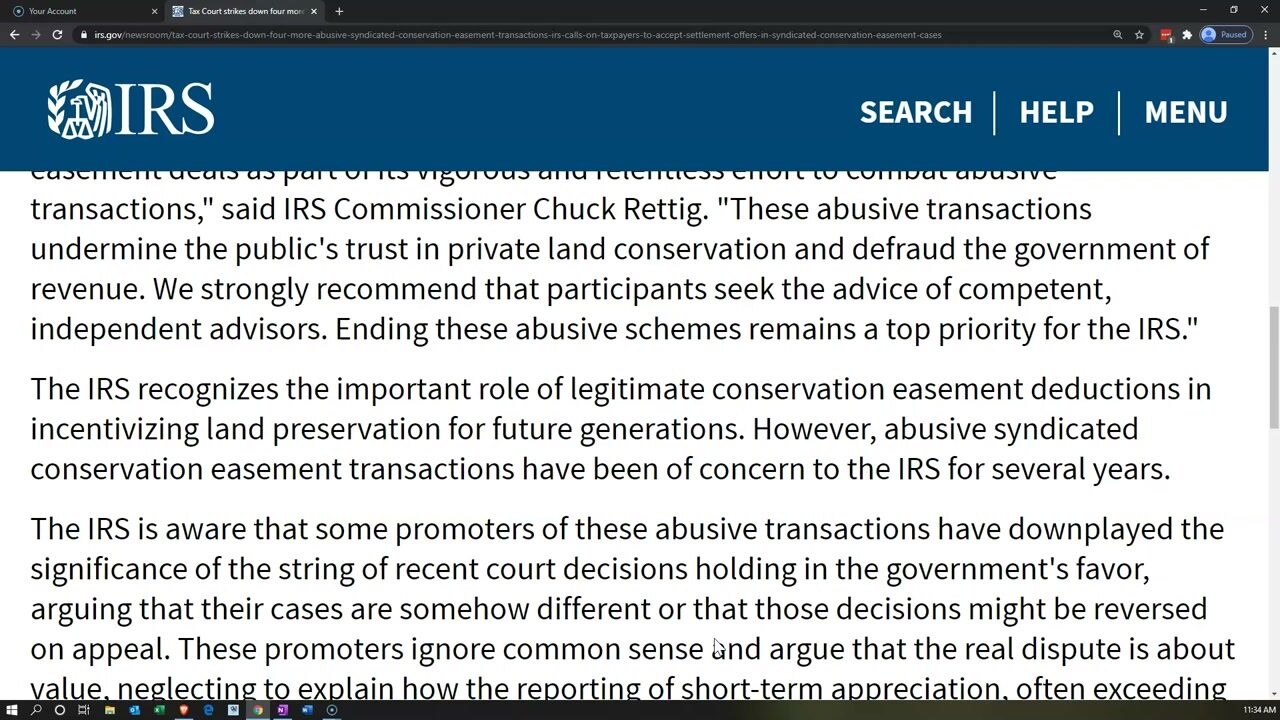
The U.S. Court of Appeals for the Eleventh Circuit ruled on August 20, 2026, that a Georgia real estate partnership's charitable deduction for donating a conservation easement was properly capped at the property's $416,563 cost basis, not the $8.9 million the partnership had claimed on its return. The court also upheld a 40% gross valuation misstatement penalty against Mill Road 36 Henry, LLC, closing out a dispute that has become a marker case, docketed as No. 24-11334, for how aggressively the IRS and courts are policing syndicated conservation easements.
What changed
Mill Road 36 Henry donated an easement on roughly 40 acres in Henry County, Georgia, to a land trust in 2016 and claimed an $8.9 million deduction based on an appraisal of the easement's value. The Tax Court had already found that appraisal grossly inflated, independently valuing the easement at about $900,000. But the Eleventh Circuit went further, agreeing that the deduction should be limited under Internal Revenue Code Section 170(e)(1)(A) to the partnership's cost basis in the land, just over $416,000, because the land had been held as inventory for sale in the ordinary course of business by the contributing partners rather than as a long-term capital asset. Basis, not appraised value, is the ceiling on a charitable deduction for property that would generate ordinary income, not capital gain, if sold.
Who is affected
The ruling lands squarely on investors who bought into syndicated conservation easement partnerships, a structure the IRS has spent nearly a decade unwinding through audits, a 2020 elective settlement program, and now a wave of appellate decisions. It is also a caution for real estate developers and investors more broadly: land purchased or held for development, subdivision, or resale can be treated as inventory rather than a capital asset, and that characterization alone can gut a later charitable deduction no matter how the easement itself is valued.
The after-tax math
The gap between what Mill Road 36 Henry claimed and what it was allowed illustrates the stakes. Example: an investor in the top 37% federal bracket who was allocated a share of the claimed $8.9 million deduction might have expected roughly $3.3 million of federal tax savings from that allocation. Limiting the deduction to the $416,563 basis cuts the available write-off by about 95%, to roughly $154,000 of tax savings at the same rate, before the 40% penalty on the disallowed portion is even applied. The penalty compounds the loss: it is assessed on the underpayment attributable to the inflated valuation, on top of back taxes and interest, with no reasonable-cause defense available once a gross valuation misstatement is found.
Why the basis rule matters more than the appraisal fight
Most conservation easement litigation has centered on whether an appraisal overstated an easement's value, a fact-intensive fight the IRS often wins but not always by much. The basis limitation is different: it does not depend on valuation evidence at all. If land was held primarily for sale to customers, such as parcels acquired by a developer or investment partnership for eventual subdivision and resale, Section 170(e)(1)(A) treats a donation of that property the same way it treats donated inventory, capping the deduction at cost. For partnerships that assembled land specifically to place under easement and syndicate the resulting deduction, that characterization has proven fatal regardless of how defensible the appraisal turned out to be.
Moves to discuss with your advisor
Investors who still hold interests in syndicated easement partnerships from the mid-2010s may want to review, with a CPA or tax attorney, whether the underlying land was capital-asset property in the hands of the contributing partners or inventory-like property that would trigger a basis limitation regardless of the easement's appraised value. Households considering any large non-cash charitable donation, land, art, or closely held stock, should independently stress-test the appraisal and hold documentation showing the property's tax character before claiming a deduction.
What to watch
The Eleventh Circuit's decision adds to a growing body of appellate law, following similar rulings from other circuits, that upholds both the IRS's basis-limitation theory and its valuation-misstatement penalties in syndicated easement cases. Additional appeals are still pending across other circuits, and the outcomes will shape how much exposure remains for the thousands of investors who participated in these partnerships before Congress curtailed the strategy in 2022.
Sources
After TAX is an independent publication. Articles are general information, not tax, legal or investment advice. Consult a licensed professional about your situation.