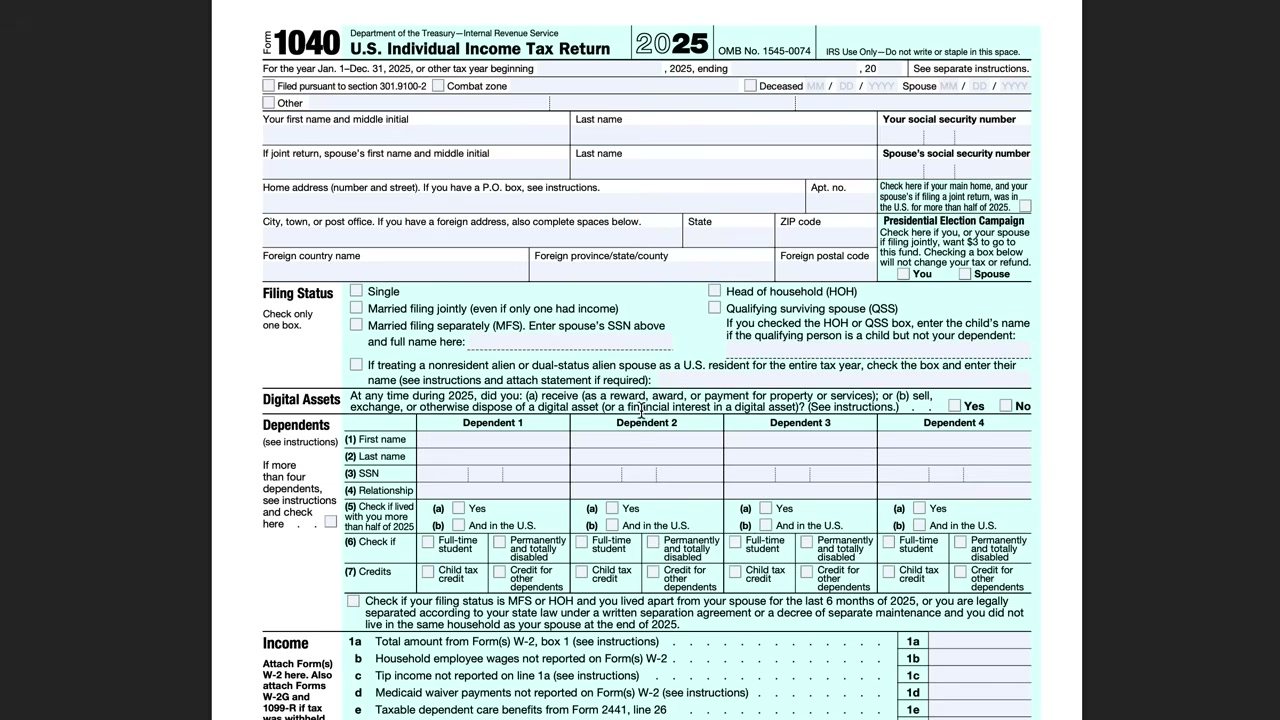
The IRS released the official 2025 Schedule 1-A on March 2, 2026, the single form taxpayers will attach to Form 1040 to claim four temporary deductions created by the 2025 tax law: no tax on tips, no tax on overtime, no tax on car loan interest, and an enhanced deduction for seniors. All four are available for 2025 through 2028, and all four disappear gradually, not all at once, above household-specific income lines built directly into the form's line-by-line math.
What changed
Schedule 1-A opens with Part I, a single modified adjusted gross income calculation pulled from Form 1040 that feeds every later part of the form. From there, a taxpayer completes only the parts that apply: Part II for qualified tips (capped at $25,000), Part III for qualified overtime pay (capped at $12,500, or $25,000 filing jointly), Part IV for interest paid on a qualifying vehicle loan, including the loan's VIN (capped at $10,000), and Part V for the enhanced senior deduction ($6,000 per qualifying spouse born before January 2, 1961). Part VI totals all four and carries the result to Form 1040. Tips, overtime and the senior deduction all require a valid Social Security number and, for married taxpayers, a joint return.
Who is affected
The four deductions do not share one phaseout formula, which is easy to miss when they are lumped together as one policy. For tips and overtime, the form reduces the deduction by $100 for every $1,000 of MAGI above $150,000 single or $300,000 joint, a 10% effective phaseout rate. For car loan interest, the reduction is steeper: $200 for every $1,000 above $100,000 single or $200,000 joint, a 20% rate. The senior deduction uses a different mechanic entirely, cutting the $6,000 base amount by a flat 6% of every dollar of MAGI above $75,000 single or $150,000 joint. A household with income spread across several of these categories has to run each phaseout separately, since a joint filer's MAGI could clear one threshold while staying under another.
The after-tax math
Example: a married couple filing jointly with $220,000 of MAGI, $8,000 of car loan interest and both spouses over 65, works through Part IV and Part V separately. For the car loan interest, $220,000 minus the $200,000 threshold leaves $20,000, divided by $1,000 and multiplied by $200, a $4,000 reduction that cuts the $8,000 interest deduction to $4,000 on line 30. For the senior deduction, the same $220,000 minus the $150,000 threshold leaves $70,000, multiplied by 6% for a $4,200 reduction, which wipes out more than two-thirds of the combined $12,000 base senior deduction, leaving $1,800 on line 37. The couple still owes tax on income that, at a lower MAGI, would have generated a much larger combined write-off.
Distinct from earlier deductions
Because Schedule 1-A phases out each benefit using MAGI, not taxable income, deductions elsewhere on the return, including retirement contributions, do not directly reduce the MAGI figure used here the way they reduce taxable income for bracket purposes. A household weighing a Roth conversion or a large capital gain in the same year should treat that decision as directly affecting how much of these four deductions survive, since MAGI on line 3 of Schedule 1-A drives every later calculation on the form.
Moves to discuss with your advisor
- Whether MAGI for the year is likely to land inside, at the edge of, or well past each of the three different threshold sets on the form.
- Whether timing a Roth conversion, bonus or capital gain into a different year preserves more of the tips, overtime, car loan interest or senior deductions.
- For households with car loan interest and senior-deduction eligibility together, whether the steeper 20% car-loan phaseout or the 6% senior-deduction phaseout matters more at their income level.
What to watch
None of these four deductions require itemizing, but all four require the taxpayer to actually complete Schedule 1-A rather than assume tax software applies them automatically from W-2 or 1099 data. The IRS has said all four provisions remain in effect only through 2028, so the phaseout math on this form is relevant to year-by-year planning for as long as the underlying law stays in place.
Sources
After TAX is an independent publication. Articles are general information, not tax, legal or investment advice. Consult a licensed professional about your situation.