The second installment of 2026 federal estimated tax is due Monday, June 15, 2026. For households paid mainly through salary, withholding usually handles the job. For high earners with restricted stock vests, large capital gains, partnership income or a business sale, the June payment is often where underpayment penalties either start or are avoided. The key is a rule that tightens once adjusted gross income passes $150,000.
What the rules say
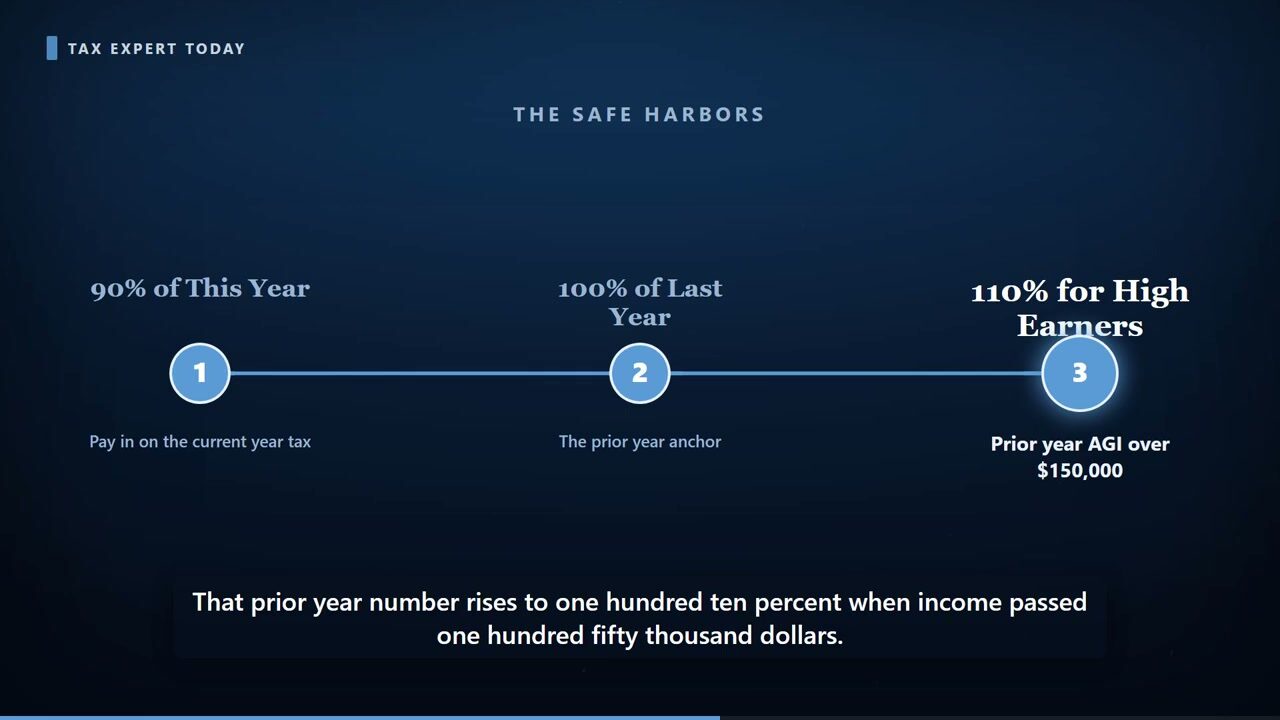
Topic 306 on IRS.gov explains the general rule. A taxpayer usually avoids the underpayment penalty by owing less than $1,000 after withholding and refundable credits. The other route is paying, through withholding and estimated tax, at least the smaller of two amounts: 90% of the current year's tax, or 100% of the prior year's tax.
The 2026 Form 1040-ES instructions add the higher-income adjustment. If adjusted gross income on the 2025 return was more than $150,000, or more than $75,000 for married filing separately, the prior-year test becomes 110% of 2025 tax instead of 100%. The current-year test stays at 90%.
Who is affected
The 110% rule reaches a broad group of professionals, executives and business owners. It matters most for households whose income arrives unevenly or without enough withholding:
- Equity compensation. Employers may withhold federal income tax on supplemental wages at a flat 22%, and must use 37% on supplemental wages above $1 million in a year, according to IRS Publication 15. For someone whose income sits in a higher bracket, 22% can leave a gap.
- Investment gains. Sales of appreciated stock, funds or real estate generally have no withholding at all.
- Pass-through income. Partnership and S corporation income reported on K-1s often arrives with no tax paid on the owner's behalf.
The after-tax math
The prior-year test is popular because the target is known in advance, even when 2026 income is not. Example: a married couple's 2025 return showed $300,000 of total tax on AGI well above $150,000. To use the safe harbor, they need to pay $330,000 for 2026 through withholding and estimated tax. Spread evenly, that is $82,500 per installment, and $165,000 cumulatively by June 15.
| Installment | Due date | Cumulative safe-harbor target |
|---|---|---|
| First | April 15, 2026 | $82,500 |
| Second | June 15, 2026 | $165,000 |
| Third | September 15, 2026 | $247,500 |
| Fourth | January 15, 2027 | $330,000 |
Suppose the same couple has an RSU vest this year that adds $600,000 of wages, and the employer withholds 22%, or $132,000. If that income is taxed at 37%, the federal tax on it is about $222,000, leaving roughly $90,000 not covered by withholding. As long as total payments reach the $330,000 safe-harbor amount, no underpayment penalty applies, even though a balance will still be due in April 2027.
Missing a target has a cost. IRS interest on underpayments was 6% for April through June 2026 and rises to 7% for July through September, according to the agency's quarterly rate table.
Moves to discuss with your advisor
- Taxpayers whose income arrives late in the year may be able to use the annualized income installment method on Form 2210, which matches required payments to when income was actually earned.
- Households with large vests sometimes ask employers about extra withholding. Others adjust W-4 elections on regular pay to close the gap.
- When 2026 income will fall sharply from 2025, the 90% current-year test may require less cash than 110% of last year's tax. That tradeoff is worth modeling with a CPA.
What to watch
The third installment is due September 15, 2026, so mid-year is a natural time to add up vests, gains and K-1 estimates. State estimated tax rules are separate and sometimes stricter. Taxpayers in states with high income taxes may want to check those deadlines and safe harbors alongside the federal ones.
Sources
- First reported Form 1040-ES, Estimated Tax for Individuals (2026) — IRS
- Topic no. 306, Penalty for underpayment of estimated tax — IRS
- Quarterly interest rates — IRS
- Publication 15 (Circular E), Employer's Tax Guide — IRS
- 2026 Second Quarter Estimated Taxes Are Due — RRBB Accountants and Advisors
After TAX is an independent publication. Articles are general information, not tax, legal or investment advice. Consult a licensed professional about your situation.